
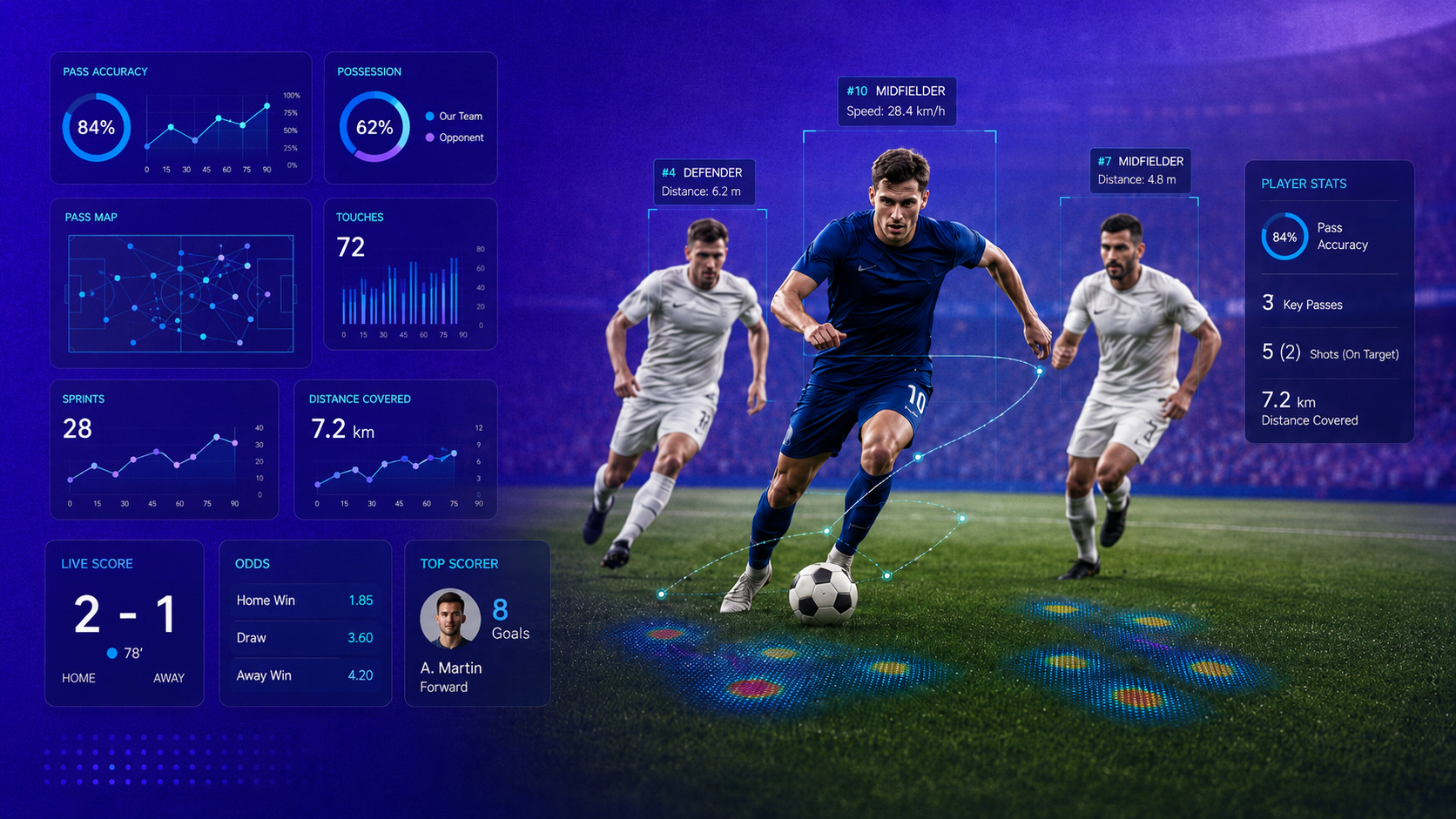
 Football is no longer just watched, it is consumed in real time through apps, dashboards, sportsbooks, fantasy platforms, AI systems, and social media experiences that constantly process live information. In 2026, the infrastructure behind modern football products has become just as important as the design users interact with.
Every second matters.
When a striker scores in the 89th minute, millions of users expect instant updates across their devices. Bettors expect live odds to adjust immediately. Fantasy football players refresh their teams in real time. Analysts monitor advanced player statistics during the match itself, not after it ends.
Behind all of this sits one critical layer: the Football API.
Choosing the right football API in 2026 is no longer simply about accessing scores. It is about reliability, speed, scalability, flexibility, and the ability to power entire ecosystems of sports experiences. The gap between an average sports platform and a great one is often determined by the quality of the data infrastructure underneath it.
Platforms like SportMicro are part of a new generation of sports data providers focused on delivering not only live scores, but also deep player statistics, live odds, real-time events, and scalable APIs designed for modern applications.
A few years ago, most football apps were relatively simple. They displayed match schedules, final scores, league standings, and basic statistics. That was enough because user expectations were lower.
Today, football products compete in an environment where users expect instant and intelligent experiences.
Modern football platforms are expected to deliver:
This shift has dramatically increased the importance of high-quality APIs.
In 2026, developers are not just searching for “football data.” They are searching for infrastructure capable of supporting products at scale.
One of the biggest differences between high-quality and low-quality football APIs is latency.
Users immediately notice delays.
If a goal notification arrives 20 seconds late, the experience already feels broken. In live betting environments, even a few seconds can create serious operational problems. Sportsbooks, analytics systems, and trading tools rely heavily on accurate and low-latency updates.
That is why modern sports APIs focus heavily on real-time architecture.
Instead of periodically refreshing data every minute, leading platforms now use streaming technologies and WebSockets to push updates instantly. This allows applications to react to events the moment they happen.
For users, the experience feels seamless. For developers, it creates the foundation for highly interactive sports products.
The football industry has become increasingly data-driven. Fans are no longer satisfied with simply knowing the final score. They want to understand the story behind the game.
Player statistics now play a central role in football applications.
A modern API in 2026 is expected to provide detailed insights such as expected goals (xG), passing accuracy, possession metrics, progressive passes, defensive duels, goalkeeper performance, shot maps, and advanced match events.
This level of detail is transforming how football is consumed.
Fantasy sports platforms use advanced player data to create more engaging experiences. AI prediction systems analyze patterns across thousands of matches. Betting intelligence platforms monitor player form and tactical trends in real time.
Without rich data structures, these products simply cannot function effectively.
Another major evolution in football APIs is the integration of live odds and betting intelligence.
Sportsbooks today require far more than static pre-match markets. They operate in an environment where odds constantly move based on:
This creates an enormous technical challenge.
During high-profile matches, odds may change hundreds of times within minutes. APIs powering sportsbooks must process this information reliably while maintaining low latency and consistent uptime.
In 2026, the most valuable sports APIs are the ones capable of combining multiple layers of information together, live scores, player data, statistics, betting markets, and external signals, within a unified ecosystem.
That is where modern platforms like SportMicro are positioning themselves differently from traditional sports data providers.
One of the most underestimated aspects of a Football API is competition coverage.
Many providers focus only on the world’s biggest leagues. While that may work for smaller projects, serious sports products often need much broader access.
Sportsbooks, scouting systems, prediction engines, and analytical platforms increasingly rely on:
A platform’s flexibility often depends on how extensive its coverage is.
Developers building global products cannot afford APIs with major data gaps. As sports products expand internationally, broad and reliable coverage becomes a major competitive advantage.
Modern applications are already complex enough.
One of the biggest frustrations for engineering teams is managing multiple disconnected data providers. Using separate services for scores, odds, player statistics, and live events creates synchronization issues, inconsistent structures, and operational overhead.
That is why many companies are now moving toward unified sports data platforms.
Instead of stitching together multiple providers, developers increasingly prefer APIs that centralize everything in one ecosystem. This simplifies development, improves reliability, and dramatically reduces maintenance complexity.
In practice, this means faster product development and better user experiences.
Artificial intelligence has become deeply integrated into football technology.
In 2026, AI systems are used to:
But there is an important reality many companies discover too late:
AI is only as good as the data feeding it.
Even the most advanced machine learning models become unreliable if the underlying football data is delayed, inconsistent, or incomplete.
This is why modern sports APIs are increasingly designed not only for frontend applications, but also for AI systems and automated analytical workflows.
Structured event data, historical datasets, live streams, and enriched statistics are becoming essential components of the sports technology stack.
A football API is not just another service dependency. For many companies, it becomes mission-critical infrastructure.
When APIs fail during major matches, the consequences are immediate:
Reliability is therefore just as important as features.
The best APIs in 2026 focus heavily on uptime, infrastructure stability, scalable architecture, and predictable performance under pressure. Major sports events generate enormous spikes in traffic, and only well-designed systems can handle those moments consistently.
For developers and product teams, choosing a stable provider is often more valuable than choosing the provider with the longest feature list.
Football APIs are evolving from simple data services into full sports intelligence platforms.
The future is moving toward systems capable of combining:
The companies building modern sports products are no longer looking for basic score feeds. They are looking for infrastructure that can help them innovate faster and create smarter experiences.
This is why platforms such as SportMicro are becoming increasingly relevant in the sports technology ecosystem. The market is shifting toward flexible, real-time, AI-ready sports data platforms capable of supporting the next generation of applications.
The football industry in 2026 moves faster than ever before. Fans expect instant information, sportsbooks demand real-time precision, and AI systems require massive amounts of structured data to operate effectively.
At the center of this transformation is the Football API.
The best football APIs are no longer simply tools for developers. They are the infrastructure powering entire digital sports ecosystems.
As sports technology continues evolving, the importance of reliable live scores, deep player statistics, scalable odds infrastructure, and intelligent data systems will only continue to grow.