
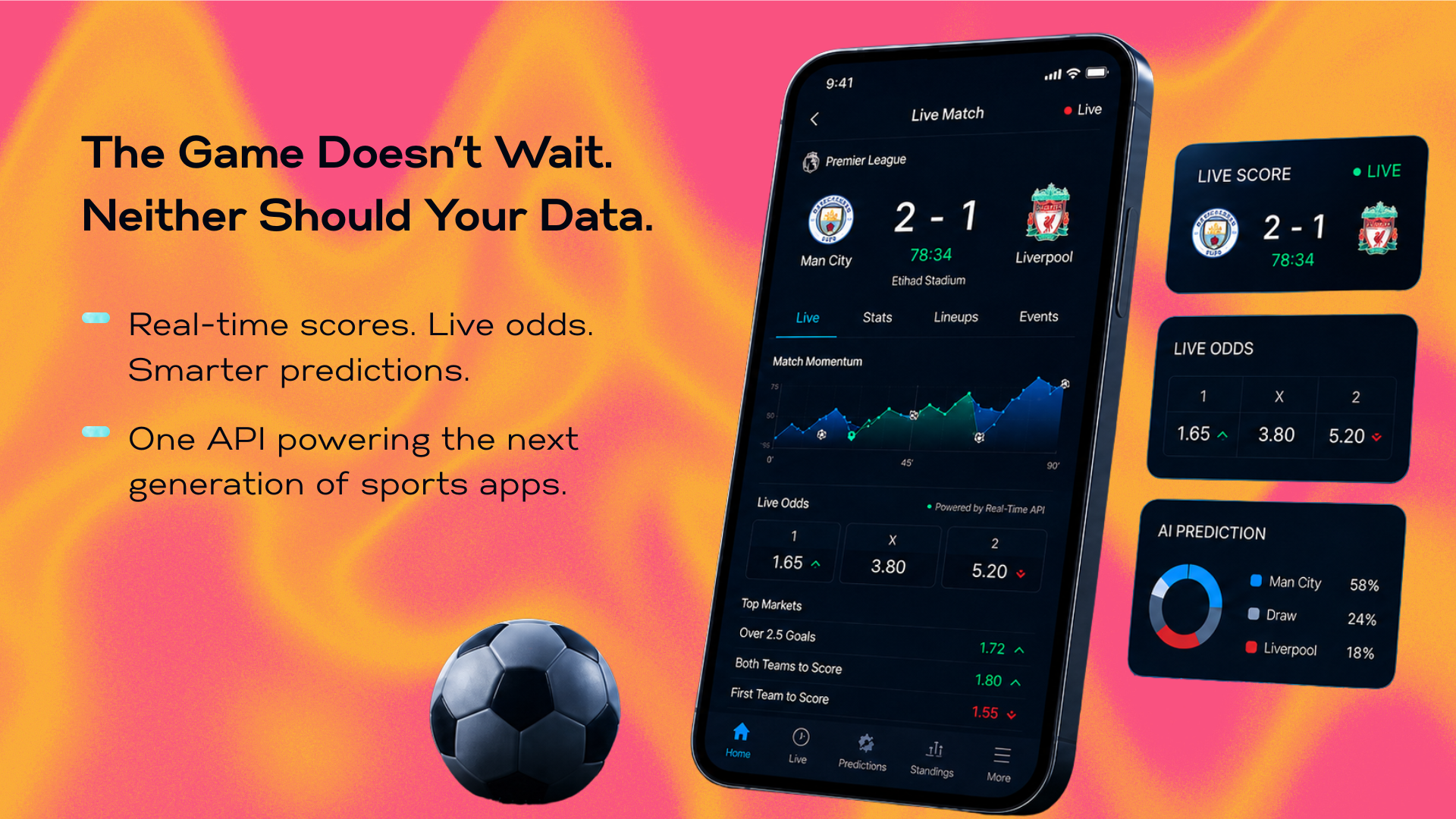
 The sports industry has changed dramatically over the last few years. What was once limited to simple score updates on television or delayed statistics on websites has evolved into a fully real-time digital experience powered by modern APIs and live data infrastructure.
Today’s sports applications are expected to deliver instant updates, live odds movement, advanced statistics, predictive insights, and interactive experiences across millions of users simultaneously. Fans no longer want to wait for refreshes or delayed feeds. They expect every goal, every red card, every touchdown, and every odds change to appear instantly on their devices.
Behind these modern experiences are real-time sports APIs.
Whether it’s a fantasy sports platform, a live score app, a sportsbook, or an AI-powered prediction engine, APIs have become the foundation that powers the entire ecosystem.
Now, let’s break down how modern sports apps actually use real-time APIs and why reliable sports data infrastructure matters more than ever.
A real-time sports API is a service that provides structured sports data directly to applications through developer-friendly endpoints and streaming technologies.
This data can include:
Modern providers usually deliver this data through a combination of REST APIs and WebSockets.
REST APIs are commonly used for scheduled requests such as fixtures, standings, or historical statistics, while WebSockets are used for instant live updates that need to appear in real time without constant refreshing.
This combination allows sports platforms to create fast, scalable, and highly interactive user experiences.
In modern sports products, speed is not just a technical feature anymore — it directly impacts user retention, engagement, and revenue.
A delay of even a few seconds can completely change the experience for users.
For example:
Users today compare sports applications against the fastest platforms in the market. They expect near-instant updates across every device they use.
That is why modern sports companies invest heavily into low-latency sports data infrastructure and real-time delivery systems.
Live score platforms are among the most data-intensive products in sports technology.
These applications continuously process and display:
The challenge is not only collecting this data, but distributing it instantly to thousands or millions of concurrent users.
Most modern live score platforms rely heavily on WebSocket infrastructure because polling APIs every few seconds becomes expensive and inefficient at scale.
With WebSockets, users receive updates instantly as events happen on the field.
This is why modern sports fans can now follow matches in real time from anywhere in the world with almost no delay.
Fantasy sports applications have become one of the biggest consumers of sports data APIs.
Modern fantasy platforms use APIs to track:
Fantasy users expect their rankings and points to update instantly during live matches.
If statistics are delayed or inaccurate, users lose trust in the platform very quickly.
This is especially important in large fantasy tournaments where even a single assist or rebound can change leaderboard rankings and prize outcomes.
For fantasy companies, data reliability is often just as important as the user interface itself.
Sports betting platforms are among the most technically demanding systems in the industry.
Unlike regular sports apps, sportsbooks deal with constantly changing probabilities and financial risk.
Modern sportsbooks use real-time odds APIs to manage:
During live events, odds can change every few seconds depending on what happens in the match.
A goal, injury, red card, timeout, or momentum shift can instantly impact betting probabilities.
This is why sportsbooks require ultra-fast infrastructure with low latency and stable real-time delivery.
Many modern sportsbooks also combine traditional odds feeds with AI systems and predictive models to automatically adjust markets based on live match conditions and external signals.
One of the fastest-growing areas in sports technology is predictive analytics powered by artificial intelligence.
Modern sports applications increasingly combine:
to generate intelligent predictions and insights.
These prediction systems can be used for:
As machine learning models continue improving, sports APIs are evolving beyond simple raw data providers into full intelligence platforms.
The future of sports technology will not only depend on who has the fastest data, but also on who can interpret that data most effectively.
Most modern sports platforms use both REST APIs and WebSockets together because each serves a different purpose.
REST APIs are ideal for:
They are easy to integrate and work well for applications that do not require instant updates.
However, REST APIs usually rely on polling, meaning applications repeatedly request new data every few seconds.
This can increase latency and infrastructure costs.
WebSockets maintain a persistent connection between the server and the client.
Instead of requesting updates repeatedly, the server instantly pushes new data to connected users whenever something changes.
This makes WebSockets ideal for:
Modern sports applications rely heavily on WebSockets because they create a significantly smoother and faster real-time experience.
Choosing a sports data provider is one of the most important technical decisions for any sports platform.
Not all APIs provide the same level of speed, reliability, or coverage.
Developers should evaluate providers based on several key areas.
Fast delivery matters enormously for live experiences, especially in betting and fantasy applications.
A strong provider should support multiple sports, leagues, tournaments, and competitions worldwide.
Downtime during major sporting events can severely damage user trust and business revenue.
Historical statistics are essential for machine learning, analytics, and prediction systems.
Modern sports products require real-time streaming infrastructure.
Traffic spikes during major tournaments can be enormous, so infrastructure stability matters heavily.
The sports technology industry is moving rapidly toward fully intelligent and personalized experiences.
Future APIs will increasingly include:
Sports platforms are no longer competing only on design or features.
They are competing on speed, reliability, intelligence, and the quality of the underlying data infrastructure.
At SportMicro, we focus on providing modern sports data infrastructure for developers, startups, sportsbooks, fantasy platforms, and analytics companies.
Our platform provides:
Whether you are building a live score app, fantasy sports platform, AI prediction engine, or sportsbook infrastructure, reliable real-time data is the foundation that powers the experience.
Modern sports products demand more than simple score updates.
They require speed, scalability, and intelligent data systems built for real-time experiences.
Real-time sports APIs have become one of the most important technologies in the modern sports industry.
From live scores and fantasy apps to sportsbooks and AI prediction systems, nearly every major sports platform depends on fast and reliable sports data infrastructure.
As fan expectations continue rising, the companies that deliver instant, intelligent, and scalable sports experiences will define the future of sports technology.
The next generation of sports products will not simply display data.
They will transform data into real-time experiences.