
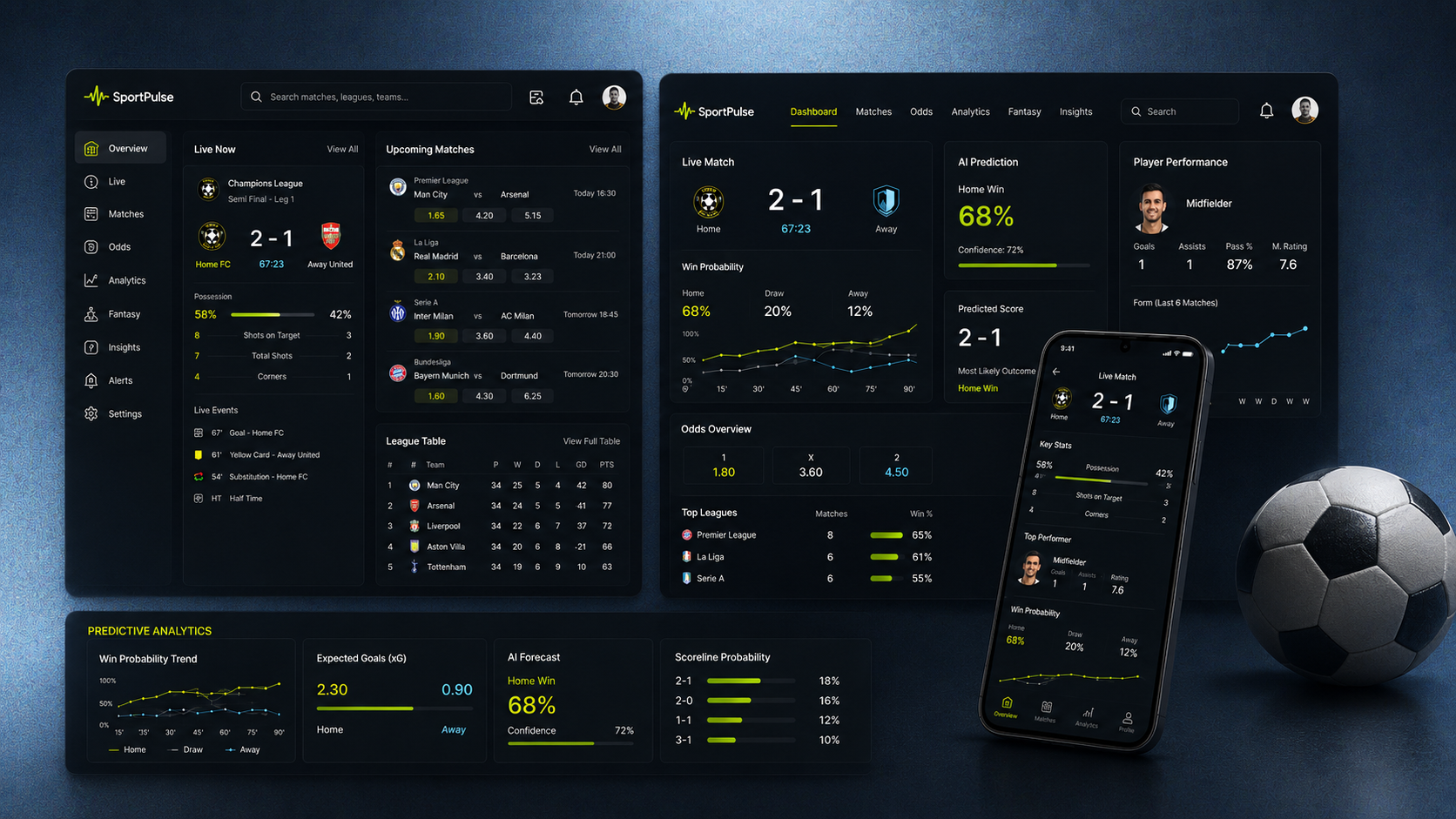
 Sports APIs have become one of the most important foundations of modern digital sports products. Behind nearly every sportsbook, fantasy sports application, analytics platform, live score app, and AI prediction system is a constant stream of real-time sports data powering the experience users interact with every day.
In 2026, sports data is no longer just an additional feature that improves a product. It has become the infrastructure layer that determines whether a platform feels fast, intelligent, and reliable — or outdated and unusable.
The growth of live betting, fantasy sports, AI-driven analytics, and automated sports media has dramatically increased the demand for reliable APIs capable of processing enormous amounts of information in real time. Fans expect instant updates. Bettors expect odds to move immediately after events happen. Fantasy players want live performance tracking without delays. AI systems require massive structured datasets in order to generate meaningful insights.
This transformation has created a completely new generation of sports technology companies focused on building scalable sports infrastructure. Platforms like SportMicro are part of this shift, helping developers and businesses build sports products powered by real-time scores, live odds, player statistics, and advanced analytics systems.
One of the largest and fastest-growing use cases for Sports APIs is the betting industry.
Modern sportsbooks operate entirely on live data. Every odds update, market suspension, score change, player event, and betting decision depends on information arriving instantly and accurately. During major football matches, odds may change hundreds of times within minutes depending on goals, cards, injuries, substitutions, or sudden shifts in betting activity.
For sportsbooks, speed is everything.
A delay of even a few seconds can create operational risks and poor user experiences. This is why modern betting platforms invest heavily in low-latency sports data systems capable of delivering real-time updates with maximum reliability.
But sportsbooks today require far more than simple score feeds.
They increasingly rely on APIs capable of delivering live odds, player statistics, historical performance data, betting intelligence signals, and advanced event tracking within one unified ecosystem. Instead of combining multiple disconnected providers, many companies now prefer centralized sports platforms that simplify development while improving infrastructure stability.
This is especially important as betting platforms continue expanding into live betting, player props, micro-markets, and AI-assisted trading systems.
Fantasy sports have evolved dramatically over the last few years.
What once started as relatively simple point-based games has transformed into highly interactive platforms driven by advanced real-time data and personalized analytics. Modern fantasy users no longer want to wait until the end of a match to see updates. They expect every pass, assist, shot, tackle, substitution, and goal to affect their fantasy experience instantly.
This demand has pushed fantasy platforms to rely heavily on real-time sports APIs.
Detailed player statistics have become one of the most valuable components of fantasy sports infrastructure. Metrics such as expected goals (xG), passing accuracy, defensive actions, possession involvement, and player efficiency ratings are increasingly integrated into fantasy scoring systems and analytical tools.
Fantasy sports companies are also beginning to use artificial intelligence to improve user engagement. AI systems connected to sports APIs can now generate lineup suggestions, player recommendations, injury alerts, performance projections, and predictive insights based on both historical and live data.
The deeper and more structured the data becomes, the more intelligent and engaging fantasy platforms are able to become.
Artificial intelligence is rapidly reshaping the sports industry.
In 2026, AI systems are being used across nearly every segment of sports technology. Betting companies use machine learning models to identify anomalies and market inefficiencies. Analytics platforms generate predictive insights from historical performance patterns. Media companies automate sports reporting through AI-generated content. Professional clubs analyze tactical and player performance data to improve scouting and recruitment decisions.
But AI systems are only as powerful as the data feeding them.
Without structured, reliable, and real-time sports data, even advanced machine learning models become inaccurate and inconsistent. This is why sports APIs have become critically important in the AI era.
Modern APIs provide far more than scores alone. They deliver event streams, advanced player statistics, historical datasets, betting market movements, and enriched contextual information that AI systems can process and analyze continuously.
As AI adoption accelerates, the relationship between sports data providers and intelligent analytics systems will only become stronger.
Live score applications remain one of the most recognizable use cases for Sports APIs, but even this category has evolved significantly.
Users today expect immersive live experiences rather than static scoreboards. A modern sports app now includes live commentary, advanced statistics, momentum indicators, personalized notifications, player insights, and continuously updating match visualizations.
The challenge behind these platforms is real-time synchronization.
Fans expect notifications to arrive instantly after events happen in the stadium. A delayed goal alert immediately damages the experience and reduces user trust. This has pushed sports infrastructure providers toward low-latency architectures capable of delivering updates within seconds through WebSockets and real-time streaming systems.
As competition between sports platforms increases, user experience increasingly depends on how quickly and accurately information is delivered.
One of the fastest-growing sectors in sports technology is betting intelligence.
These systems go beyond displaying scores or odds. Instead, they analyze enormous amounts of data in order to identify meaningful insights, market patterns, and predictive opportunities.
Modern betting intelligence platforms monitor live odds movements, player form, injuries, match momentum, statistical trends, and even external factors such as news events or social sentiment. AI systems process these signals continuously to identify situations that may indicate valuable betting opportunities or unusual market behavior.
This type of infrastructure requires extremely rich sports datasets and reliable real-time processing capabilities.
As sportsbooks become more competitive and data-driven, betting intelligence systems are increasingly becoming essential operational tools rather than optional analytical features.
Sports media is also undergoing major transformation through APIs and automation.
Traditional sports journalism is increasingly being combined with real-time data systems capable of generating dynamic and interactive experiences for readers. Modern sports media platforms now include live match centers, automated statistical summaries, player dashboards, AI-generated previews, and continuously updating visualizations.
Sports APIs allow publishers to create richer experiences while significantly increasing content production speed.
Artificial intelligence is also playing a growing role in automated sports media. AI systems connected to sports APIs can now generate match recaps, betting insights, player comparisons, and performance summaries within seconds after games end.
This allows media companies to scale content production while maintaining highly data-driven experiences for users.
Another major trend in 2026 is the shift toward multi-sport ecosystems.
Instead of focusing on a single sport, many companies are building platforms that cover football, basketball, tennis, esports, hockey, baseball, and additional sports simultaneously. This creates significant technical complexity because each sport contains different event structures, statistical models, and betting systems.
Unified sports APIs help solve this challenge by providing centralized infrastructure capable of supporting multiple sports through one scalable architecture.
Platforms such as SportMicro are increasingly positioning themselves around this model, helping developers work with multi-sport data ecosystems without managing separate integrations for every individual sport.
Sports APIs are evolving far beyond basic score delivery systems.
They are becoming intelligent infrastructure layers capable of powering sportsbooks, fantasy ecosystems, AI analytics, media automation, scouting systems, and fan engagement experiences simultaneously.
As sports technology continues evolving, the demand for low-latency, AI-ready, scalable sports data infrastructure will continue growing rapidly. The companies building the next generation of sports experiences are increasingly looking for unified platforms capable of delivering not just raw data, but entire ecosystems of sports intelligence.
The future of sports technology will belong to platforms capable of transforming live sports data into intelligent real-time experiences.
Sports APIs have become one of the most valuable building blocks in the modern sports industry.
From sportsbooks processing millions of live odds updates to fantasy platforms analyzing player performance in real time, nearly every modern sports product now depends on fast and reliable sports data infrastructure.
As AI, betting technology, and interactive sports experiences continue evolving, the role of scalable APIs will only become more important.
Platforms like SportMicro represent the next generation of sports infrastructure built for real-time analytics, live betting, fantasy sports, and AI-powered sports ecosystems.